Practice Guides
From Dissociation to Presence

The purpose of these guides is to give you the practices and tools that will bring you into Presence.
On this page you will find:
The tools I have shared here are a combination of meditation, psychotherapy, body work and common sense. Most of the tools in these practice guides are incredibly simple and yet have endless depths of subtly to them that can be cultivated. If you want to get the most out of them it is worth incorporating them into a continuous daily practice.
The spiritual practices that I have been inspired by stem from Buddhism and Jungian Psychotherapy. Combining the principles of both of these in a wholehearted embodied practice opens the door to a new way of being.
The outcome is a fundamentally simple, yet profound way of experiencing the world. One firmly grounded in your physical being, yet also connected to the deep mystery and magic of interconnected life. Practicing this approach involves cultivating a deep respect for all aspects of experience.
The deepening and broadening of experience across the different parts of your being can create more wisdom, balance, resilience, maturity, love and understanding.
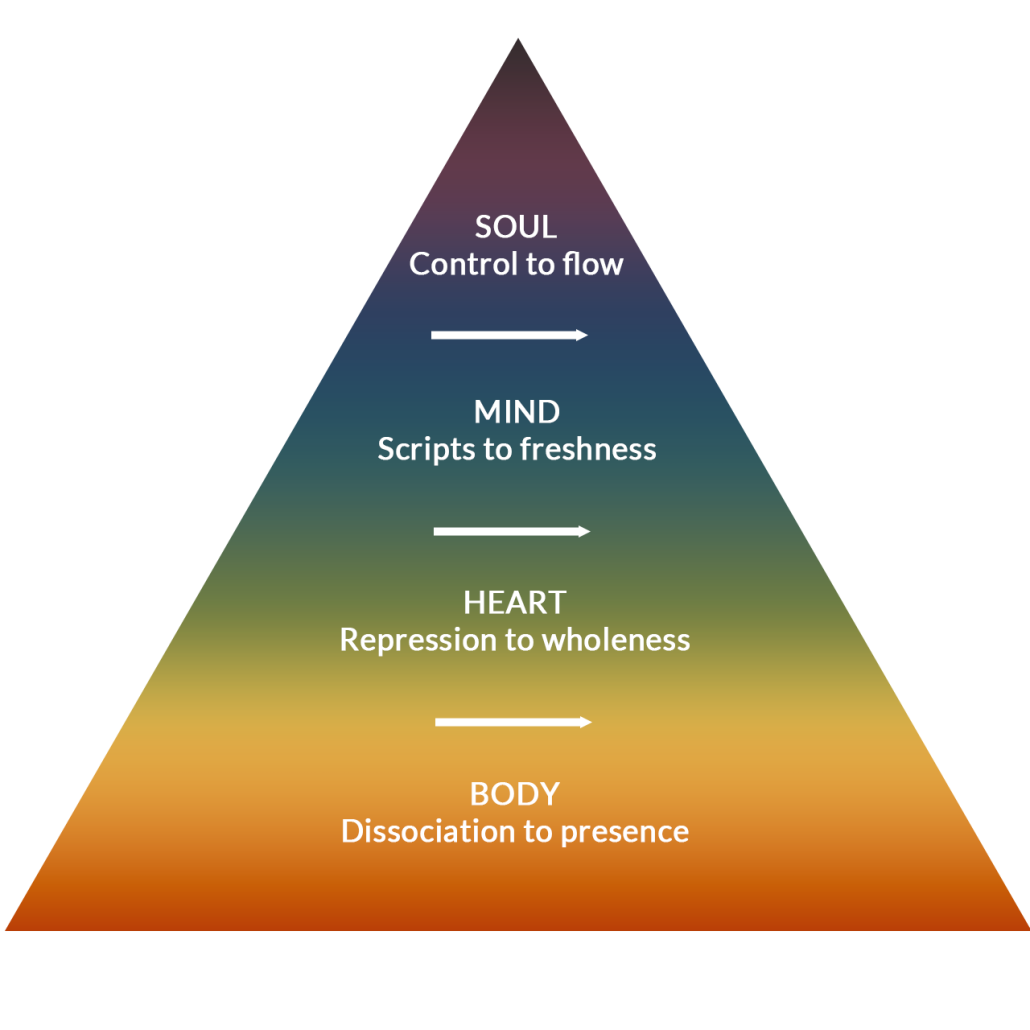
The framework divides experience into four parts. Plus there is a guide to imaginal practice.
If you engage with practice with an open heart, you can connect with and deepen your experience much faster and with a lot more ease.
With that in mind, here is a short and simple meditation practice to help you connect with your heart. You can come back to this before doing any meditative practice if that feels helpful.
Approaching practice with a sense of sincerity and fierce love – being compassionate towards yourself but not being afraid to face your stuff and do the hard work – is one of the best things you can do.
My general approach to suffering in practice is that the way out of it is through. It is not through trying to bypass or short-circuit your system that you are going to reduce your suffering, but by showing up and facing your pain and difficulties with an open heart and a deep sense of embodied compassion. In this approach difficult experiences can be experienced as alchemical opportunities. They are a chance to integrate an important part of yourself or to purify something on a deep level, releasing you into deeper and deeper freedom.
Suffering can be some of the most meaningful and transformative moments on the path.
You also need to have enough resources, courage and resilience to go through the suffering with an open heart. Otherwise, you could end up stuck, going in circles or just beating yourself up with self-judgement.
It is also worth saying that the conditions of people’s lives aren’t entirely within their control – there are plenty of factors, like systemic oppression, lack of resources and personal challenges – that will make it more difficult or impossible for individuals to cultivate the space for gaining the benefits of practice in their lives.
This doesn’t mean that it isn’t still meaningful to practice, but it’s important to recognise that sometimes what is needed most in life is practical support or just the acknowledgement that life can be really hard.
It’s also important to be upfront about the risks and potential benefits of practice so that people know what they are getting into.
All of my guides come from a place of approaching practice with a radical sense of compassion. The foundation of the guides is a respect for your body wisdom and a deep care for your wellbeing. Having this compassionate approach minimises the risk of practice going wildly out of control, as you are listening to the cues within you, like fear, and respecting your body’s natural limitations. However, there is always the chance that something too intense emerges and causes difficulties that you have trouble moving past.
It is also worth pointing out that silent meditation can be both especially rich and especially challenging if you have trauma, if you are sensitive, if you feel things very deeply, or if you are someone with a lot of life force in you.
Being sensitive has a lot of negative valence attached to it in modern culture, but if you can create the right conditions for it, sensitivity is actually a huge gift that allows you to pick up on all the subtle forms of beauty, magic, and connection in life.
One of the things I am most passionate about is shared practice.
It becomes infinitely easier to open to new aspects of experience and to accept yourself when other people are modelling this to you.
When you are in an environment where you are allowed or even encouraged to access the parts of yourselves that are normally hidden, doorways can effortlessly slide open for you that you could have spent your entire life banging your head against.
Having fun practicing together is also part of the joy of life, and if you only practice by isolating yourself from other people, the second you go back into the world, a lot of your practice is no longer relevant.
Creating spaces where you can practice together with others will help you connect with people in a more authentic way. It creates space for collective truth to emerge.
With this in mind, I have created a section of the website with some tools for facilitating shared practice.
If you have found my content useful, please donate. Thanks!