
Post three of fourteen, in section About Awakening
This post looks at how your inner world interacts with the outer world and what the implications of this are for retreats and spiritual practice.
The insides, the outsides and how they interact with each other is an incredibly complex interconnected web of entanglement that creates your entire experience.
The table below is one very simplified way of describing what I am calling the insides and outsides and shows how this concept relates to my Body, Heart, Mind, Soul framework.
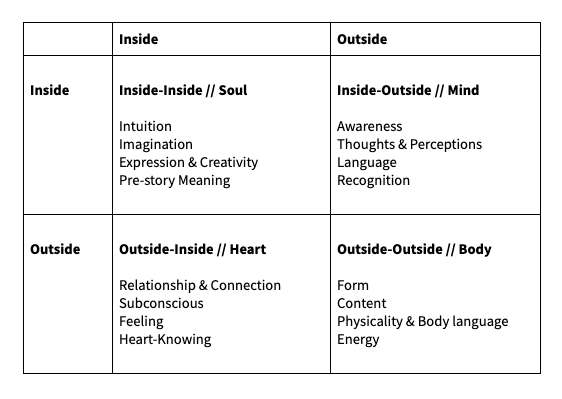
This table describes some of the key aspects of experience. It is important to recognise that within each of these aspects of being, there are things that are happening consciously within your system and things that are happening subconsciously.
Awakening happens through learning to connect with new elements of experience and processing reality differently.
Relationship
Experience is highly complex. It is always deeply interconnected and in a state of flux where it is in the process of being given or received; there are always connections and exchanges happening between the different parts of you and the world around you.
This is one aspect of non-duality and so to use this model to map someone’s present moment experience, you would need to connect every box to every other box. In real-time, all these different parts of you are always interacting with every other part of you.
To be able to visualise what someone’s experience looks like in real time using this model, you can imagine pathways or energetic threads that connect each box to every other box. It’s like an incredibly complicated, living, breathing, three-dimensional web of energy with an endless amount of connections.
There are some parts of this web that people are aware of, but mostly it is happening without that person being conscious of it.
One of the reasons that around 97% of the mind’s processing is subconscious is because there is an inordinate amount of information that is being generated in any given moment, and humans only have a limited amount of processing power. The subconscious also doesn’t include all the things your mind doesn’t even get involved with, for example, your cells interacting with each other.
Interactions
Whenever you interact with another being, both you and the other person are bringing the entirety of both your 3D energy webs to the interaction.
When you’re interacting with another person, they have their own sphere of activity that has every aspect of experience going on, that is deeply interconnected and complex, and you have yours.
By connecting with another person, every single part of your experience is interacting with every single part of their experience.
For example, your bodies will be giving each other lots of signals, while you converse on a mental level and you use your subconscious ideas to model and understand each other.
Every single part of your experiential web is connected with every single part of their web. By introducing another being into the mix, the world has just got exponentially more complex.
Not only that, but there is also an energetic web, that holds your relational context or template. There is a collective experience that exists separately to either of you as individuals. For example, people will start mirroring each other’s body language, their heart-beats start to sync up, they will have shared emotions, they will connect to shared meaning systems. It’s a collective experience that doesn’t belong to either of you, but every part of this also connects in with every other part of each of your individual experiences. This is exponentially more complex again.
Just imagine what this looks like with 10 people.
As you can see, this is totally overwhelming and you can’t process all that information, so you filter out most of your experience. A lot of it stays subconscious and the brain doesn’t process everything that is happening in the body, heart, mind and soul, nor the environment around you. It would be too much for you to be present with at once.
One way of coping with this is that humans create very strong habit pathways – for example, ways of behaving, interpreting information or responding to things. People do this in the insides and the outsides; people have habits and ways of being that are ingrained on an individual level and that emerge when they interact with others and the outside world.
Practice and Retreats
Meditation practice and going on retreat allow you to disconnect from a lot of this interaction. This is super useful for simplifying experience, which creates enough space to get some clarity on what is happening in different aspects of experience and to see a deeper layer of truth.
With a bit more spaciousness in experience, you can focus in on specific parts and see what is really present, underneath the habit pathways.
An example of how you might change these habit pathways is by concentrating on certain aspects of experience and reshaping how you process that information. For example, if you are doing Vipassana meditation, where you are noticing the impermanence of mental perceptions, you can change the way your mind processes experience on a really fundamental level.
Another example of changing these habit pathways is choosing where to put your attention and, through practice, creating different attractor points for where your experience naturally flows over time. For example, by focusing on heart states and practicing what this entails, you will have more capacity to be in these states.
It’s important to recognise that any metaphysics or ideas about the nature of reality that are introduced through practice or on retreat may be flattening the full multi-dimensionality and complexity of experience. Simplified ideas can be helpful to adopt in order to understand specific aspects of experience more deeply, but for the sake of truth and realness, it’s important to keep a perspective of how that fits into the fullness of being a being in the world.
Experiences that can happen in a retreat context can’t always be accessed in a more everyday setting where the complexity of what is present is much higher.
Introducing some practices that include more of this complexity in a retreat setting, for example, relational practices, can mean that insights are more likely to integrate into how you experience daily life.
By exploring what experience is when in relationship with other people and sharing what is present in this moment in a safer place, you can relearn ways of being while you are in connection. You can practice things like deep listening, connecting with sensations that come up in relationship, and opening to more authentic ways of being, all of which can transform how you experience and show up in your relationships.
Seeing things from other people’s perspectives and connecting with other people’s experiences also creates opportunities to discover new things, which can sometimes help you move forward a lot faster in your practice and avoid getting stuck in your same inner patterns.
Unless your objective with meditation is to completely detach from life and reality, then it makes sense for the practice to explicitly include some of the ways in which you relate to others and the world around you.
Through any of these ways of changing your connections, it’s possible to change your entire way of experiencing and being.